Introduction: The Outdoor IoT Display Dilemma
If you’ve ever built a portable or Battery Powered Display project, you’ve likely faced the classic display compromise.
Standard IPS and AMOLED panels deliver rich colors and high frame rates indoors, but they turn into battery-draining mirrors the moment you step into direct sunlight. On the flip side, E-Paper (E-Ink) displays offer paper-like daylight readability and near-zero static power draw, yet their agonizingly slow refresh rates and screen flashing make responsive user interfaces nearly impossible.
This brings us to a crucial question: Do you really have to choose between battery life and fluid screen updates?
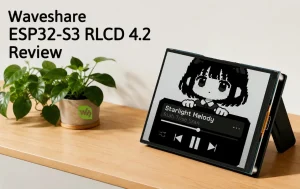
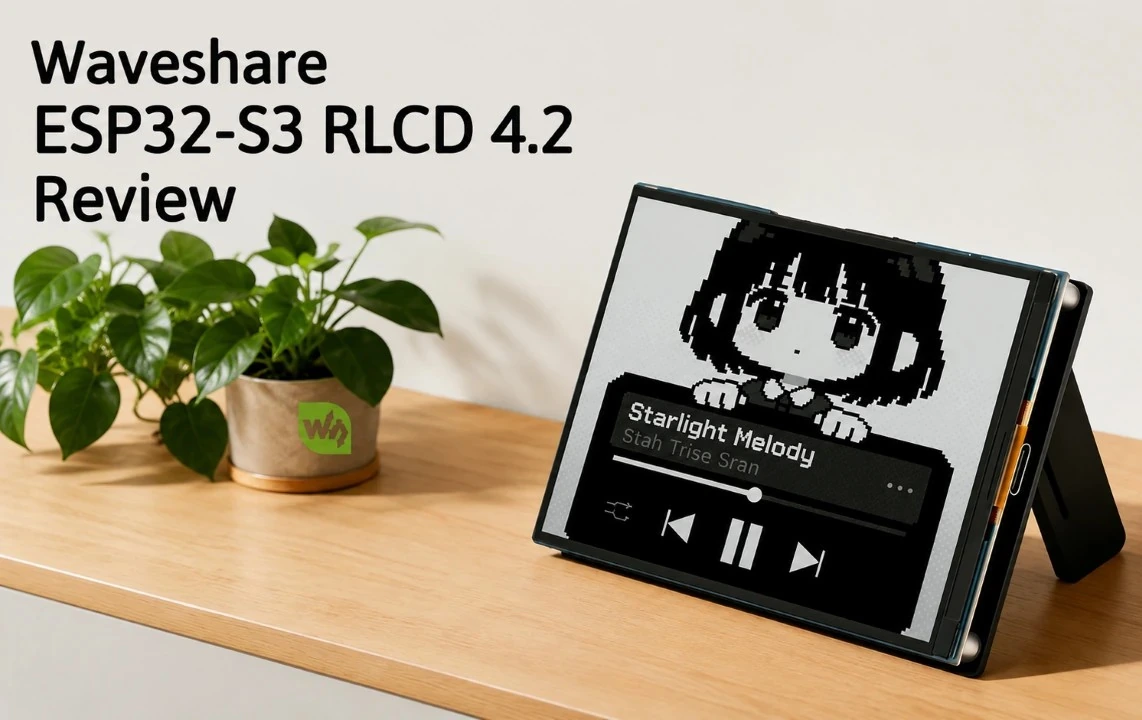
Enter the Waveshare ESP32-S3 4.2 RLCD, an innovative RLCD Development Board. Positioned by embedded engineers and tech reviewers as a high-speed ESP32-S3 E-paper Alternative, this board eliminates the power-hungry LED backlight entirely. Powered by a Reflective LCD ESP32 panel driven by the ST7305 controller and paired with Espressif’s dual-core wireless MCU, it bridges the gap between low energy draw and smooth visual feedback as a premier Sunlight Readable ESP32 Display.
📊 RLCD Market Positioning
| Display Technology | Power Consumption | Refresh Rate | Ideal Market Fit |
IPS / AMOLED |
High (Power-heavy backlight) | Ultra-Fast (60Hz) | Indoor media, rich color UI, video playback |
Waveshare ESP32-S3 4.2 RLCD |
Low (Zero backlight draw) | Fast & Smooth (30Hz) | The Sweet Spot: Outdoor IoT Display + responsive UI |
E-Paper (E-Ink) |
Minimal (Zero when static) | Ultra-Slow (1-3 seconds) | Static labels, e-readers, infrequent updates |
More than just an Ambient Light Display glued to a microcontroller, Waveshare designed this ESP32-S3 Display Board as a complete AIoT development ecosystem. Packed with dual MEMS microphones, an audio codec, an environmental sensor, and battery management, it targets the exact sweet spot where outdoor visibility, power efficiency, and ESP32 Voice Interface capabilities intersect.
What Powers this ESP32-S3 RLCD Board?
At first glance, the board resembles a sleek smart desk ornament, but under the acrylic hood lies a feature-packed system-on-board that eliminates the need for messy breadboard wiring.
1. Dual-Core Processing & PSRAM Muscle
At its core, the board features the ESP32-S3-WROOM-1-N16R8 module:
-
Xtensa 32-bit LX7 Dual-Core CPU: Clocks up to 240MHz with dedicated vector processing instructions for TinyML ESP32 signal pipelines.
-
16 MB Flash & 8 MB PSRAM: Provides ample headroom for buffering high-resolution LVGL ESP32 framebuffers, handling network stacks, and streaming audio buffers simultaneously.
-
Wireless Connectivity: Integrated 2.4 GHz Wi-Fi (802.11 b/g/n) and Bluetooth 5 (LE) for cloud sync and local mesh networks.
🔗 See Energy-Aware TinyML on ESP32: What the Benchmarks Reveal .
2. The Display: 4.2-inch Reflective TFT / RLCD
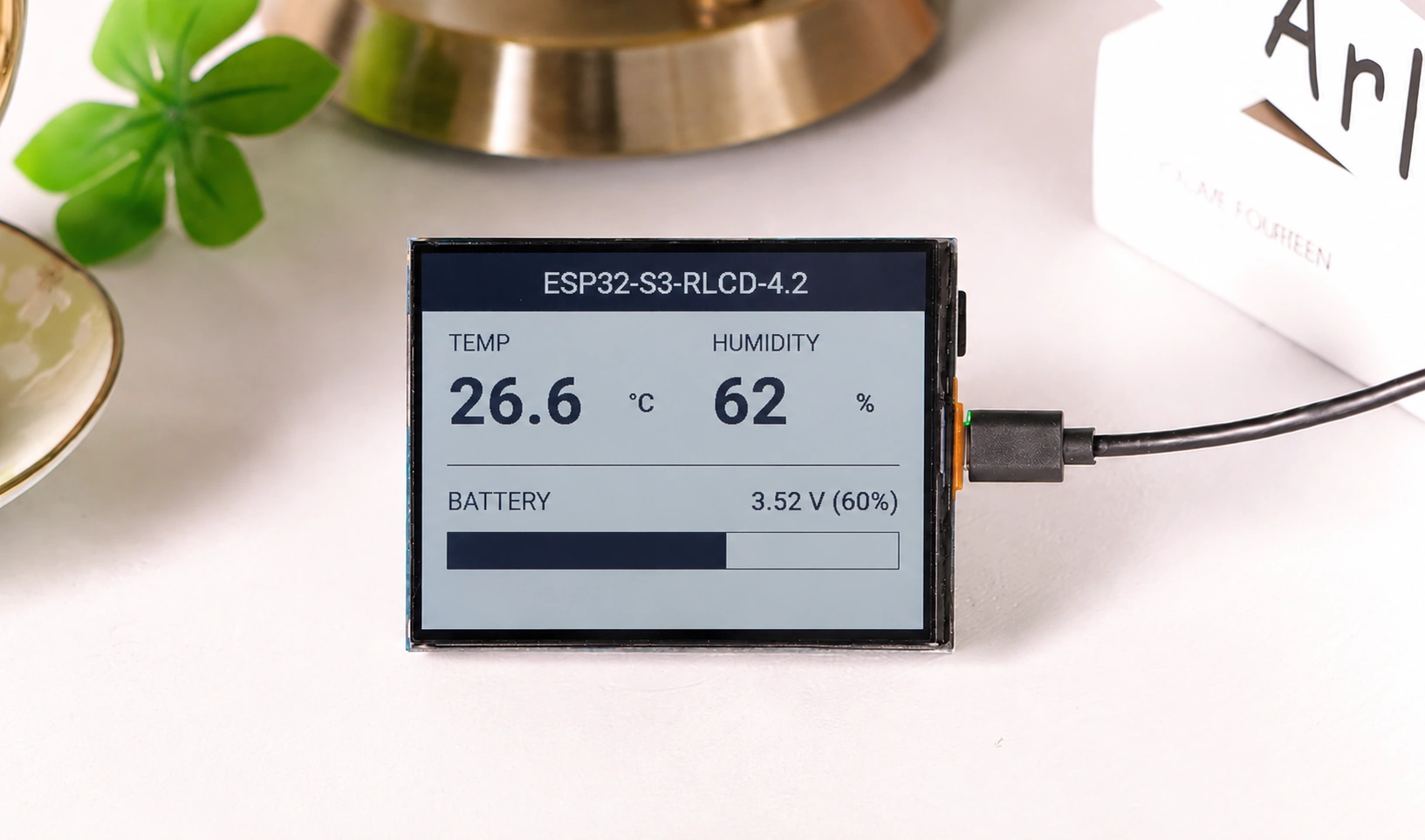
Driven over SPI by the ST7305 driver IC, the 300*400 pixel monochrome Reflective TFT display uses ambient light bouncing off its reflective backplate to illuminate pixels. Because there is no backlight circuit drawing constant current, energy consumption stays remarkably low while sunlight visibility remains sharp.
3. Voice & Acoustic Hardware Front-End
Unlike basic development kits, this platform treats audio as a primary feature:
-
ES7210 ADC + Dual MEMS Microphones: Hardware-level noise reduction and acoustic echo cancellation for clear voice capture.
-
ES8311 Codec & Onboard Speaker: Drives the included 2W,8ohm speaker via an MX1.25 quick-connect port.
-
AI Voice DeepSeek ESP32 Integration: Designed specifically to stream audio buffers to cloud Large Language Models (LLMs) to create an intelligent DeepSeek ESP32 AI Assistant.
4. Off-Grid Power & Timekeeping
-
Sensirion SHTC3 Sensor: Onboard ambient temperature and relative humidity tracking.
-
PCF85063 Real-Time Clock (RTC): Maintains timekeeping during deep sleep cycles via a backup battery header.
-
Power Management: Includes an integrated 18650 Li-ion battery holder, onboard charging logic, USB Type-C interface, and reverse-polarity protection LEDs.
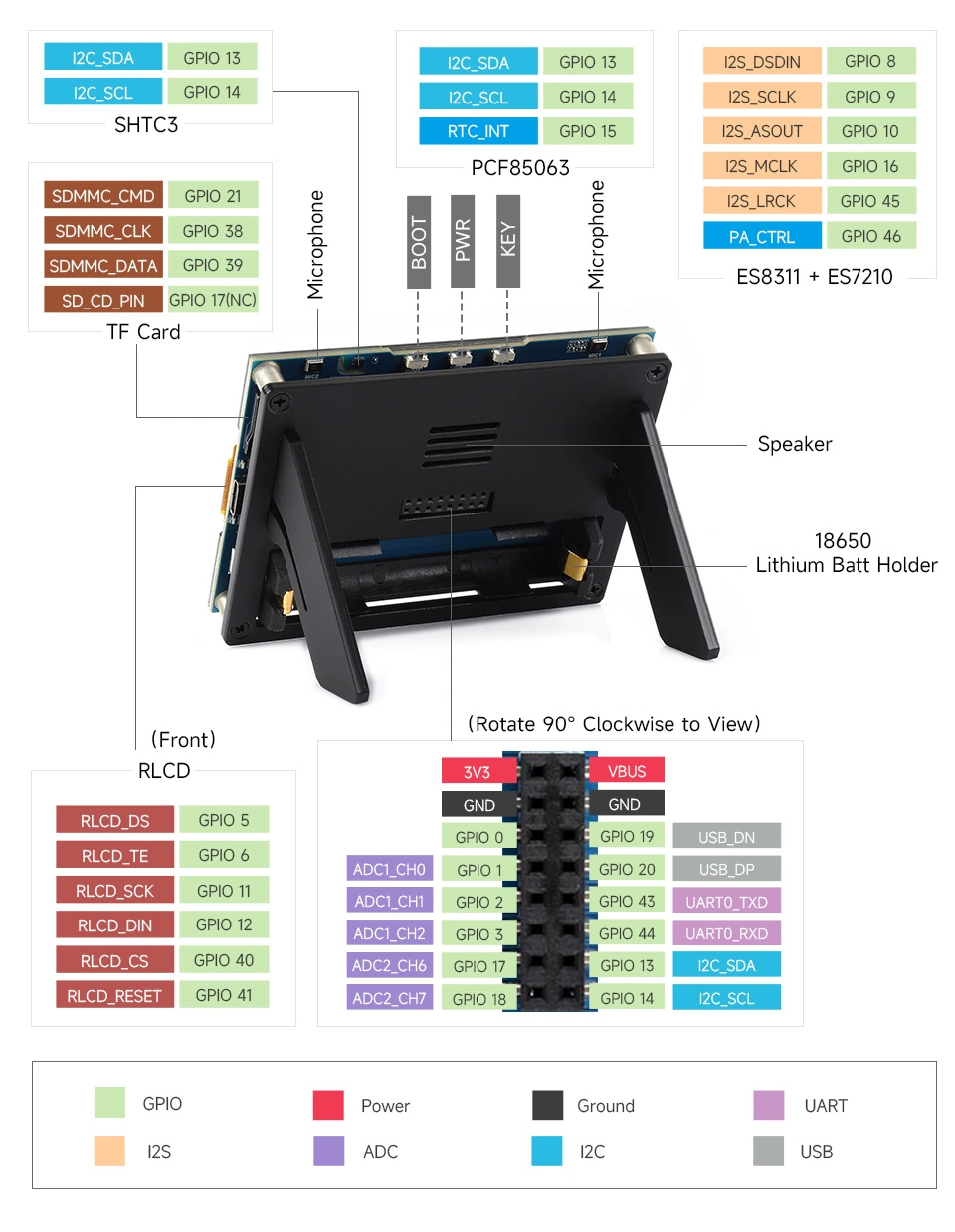
Technical Specifications of Waveshare ESP32 RLCD
| Feature | Technical Specification |
Main Processor |
Espressif ESP32-S3-WROOM-1-N16R8 – Dual-Core @ 240 MHz |
Memory |
512 KB SRAM, 16 MB SPI Flash, 8 MB Octal PSRAM |
Display Panel |
4.2-inch Monochrome Reflective LCD (Reflective LCD ESP32) |
Resolution & Driver |
300*400 pixels | ST7305 Driver IC (SPI Interface) |
Backlight |
None (100% ambient reflection; zero backlight power draw) |
Audio Hardware |
ES7210 ADC + Dual MEMS Mics | ES8311 Codec with 2W Speaker |
Sensors & RTC |
Sensirion SHTC3 (Temp/Humidity) + PCF85063 Real-Time Clock |
Storage Expansion |
MicroSD (TF) card slot supporting FAT32 |
Expansion Header |
2 x 8-pin 2.54mm pitch female header (GPIO, I2C, SPI, UART, ADC) |
Dimensions |
approx 92.5×70.1×13.5mm |
Demystifying Reflective LCD (RLCD): Why It Matters
To understand why this ESP32-S3 RLCD board is generating buzz in maker communities, it helps to see how it operates compared to emissive LCDs.
Traditional IPS or TFT screens push light through liquid crystals using a bright LED backlight. In daylight, sunlight overpowers this backlight, washing out the image.
Reflective LCD flips this mechanism: it uses ambient light as its backlight. Sunlight bounces off the reflective mirror layer behind the panel, meaning the brighter the surrounding environment, the higher the display contrast becomes.
🔬 Structural Comparison: Backlit LCD vs. Reflective LCD
Layer Component |
Traditional Backlit IPS/TFT | Reflective LCD (RLCD) |
Front Layer |
Protective Glass + Liquid Crystal Matrix | Protective Glass + Liquid Crystal Matrix |
Illumination Source |
Active LED Backlight (Continuous Power Draw) | Ambient Light Reflector (Zero Power Draw) |
Direct Sunlight Behavior |
Washed out, heavy surface glare | Enhanced contrast, crisp legibility |
Comparative Analysis: RLCD Technology Breakdown
When evaluating this RLCD Development Board, engineers often compare it against three dominant display technologies:
| Feature | Reflective LCD (RLCD) | E-Paper / E-Ink | IPS / TFT LCD | AMOLED |
| Sunlight Visibility | Excellent (Improves in sun) | Superior (Paper-like) | Poor (Washes out) | Moderate / Good |
| Refresh Speed | Fast (30Hz) | Slow (1-3 seconds) | Very Fast (60Hz) | Ultra Fast |
| Power Consumption | Low (No backlight) | Minimal (Zero static draw) | High (Backlight active) | High (Varies with pixels) |
| Dark Room Visibility | Needs Ambient Light | Needs Ambient Light | Self-Lit | Self-Emissive |
| Animations & Menus | Smooth (No ghosting) | Unusable (Flashing) | Ultra Smooth | Ultra Smooth |
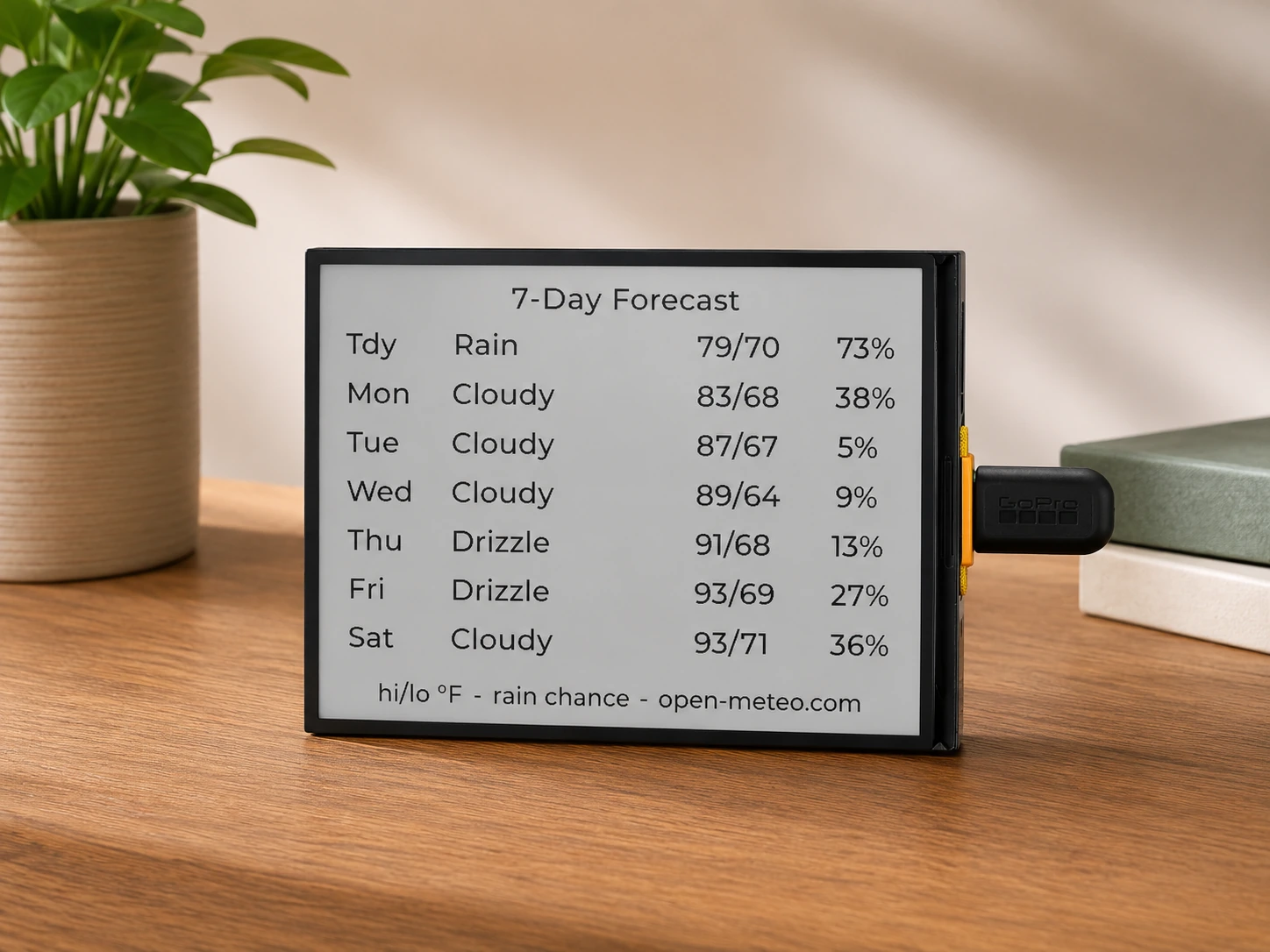
Key Trade-Off Highlights:
-
RLCD vs E-paper:
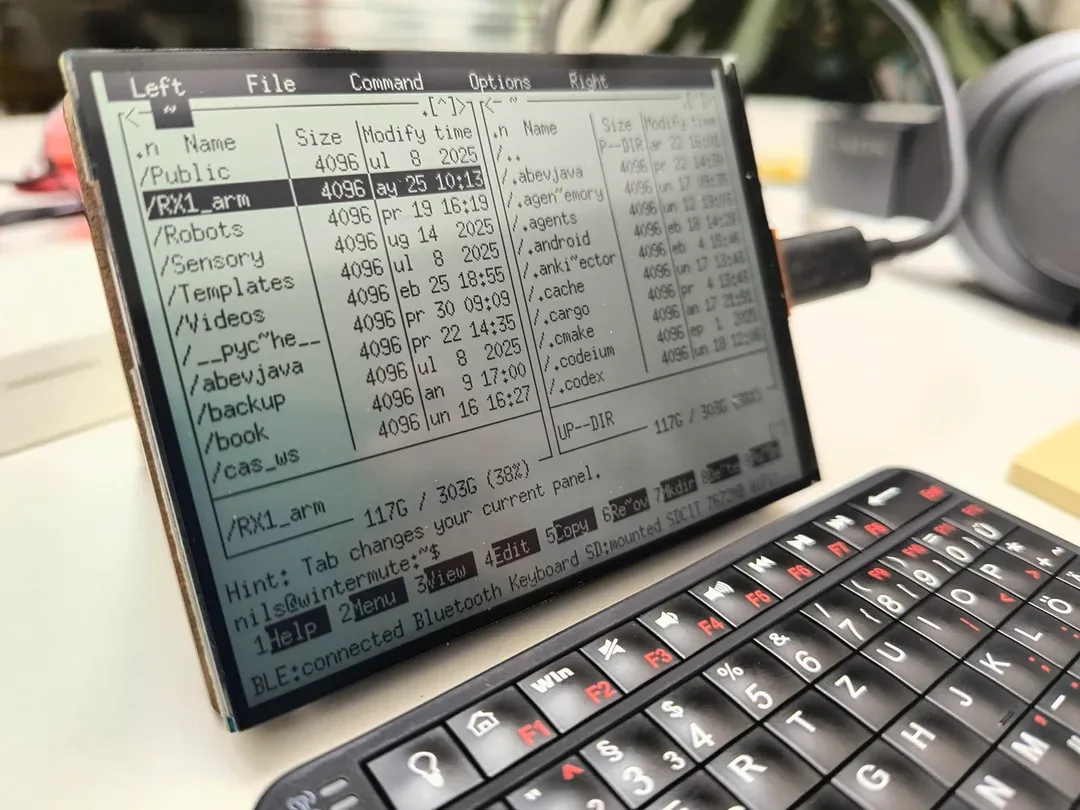
E-Paper wins on static images because it holds an image with zero power. However, in the RLCD vs E-paper matchup for interactive dashboards, live sensor plots, or animated menus, RLCD wins easily due to its fast refresh rates and lack of screen ghosting.
🔗 See LilyGO T-Echo Plus Review: The E-Paper Device You’ll Actually Take Outside . -
RLCD vs IPS LCD:
IPS panels work in dark rooms but drain batteries fast outdoors. RLCD trades dark-room operation for multi-day battery runs and outdoor legibility.
-
RLCD vs AMOLED:
AMOLED offers vibrant colors but suffers from high thermal output and battery drain under bright sunlight, whereas RLCD remains cool and readable.
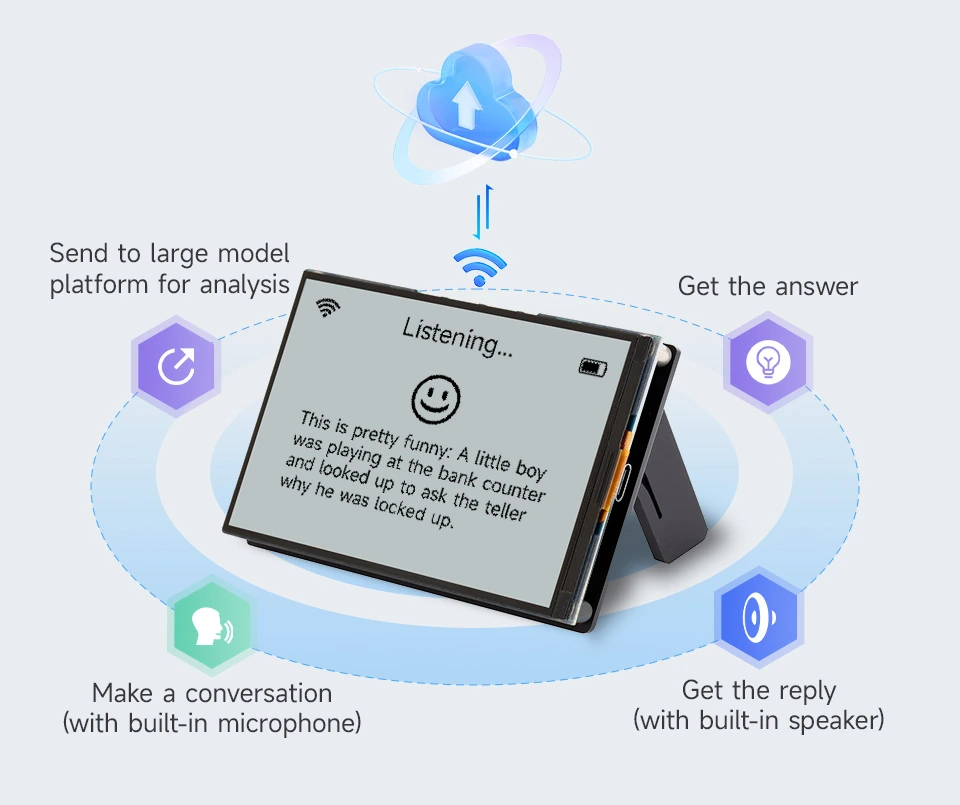
Real Applications & AI Processing Pipeline (with DeepSeek)
| Step | Hardware / Software Layer | Functional Action |
| 1 | Dual Mics + ES7210 ADC | Captures user speech for the ESP32 AI Assistant |
| 2 | ESP32-S3 (Wi-Fi Engine) | Encrypts and streams audio buffer via DeepSeek API ESP32 endpoints |
| 3 | DeepSeek LLM API | Processes voice query via AI voice DeepSeek ESP32 models or another LLMs |
| 4 | ES8311 Codec + 2W Speaker | Converts returned audio stream to spoken voice responses |
| 5 | 4.2-inch RLCD Panel | Displays real-time transcription text, status icons, or ESP32 GUI updates |
Use Cases That Shine
-
Smart Desktop Ornaments & AI Companions:
A responsive, non-intrusive ESP32 AI Assistant desktop agent that listens, speaks, and displays live data without emitting light pollution in dark offices.
-
Outdoor Telemetry & Smart Agriculture:
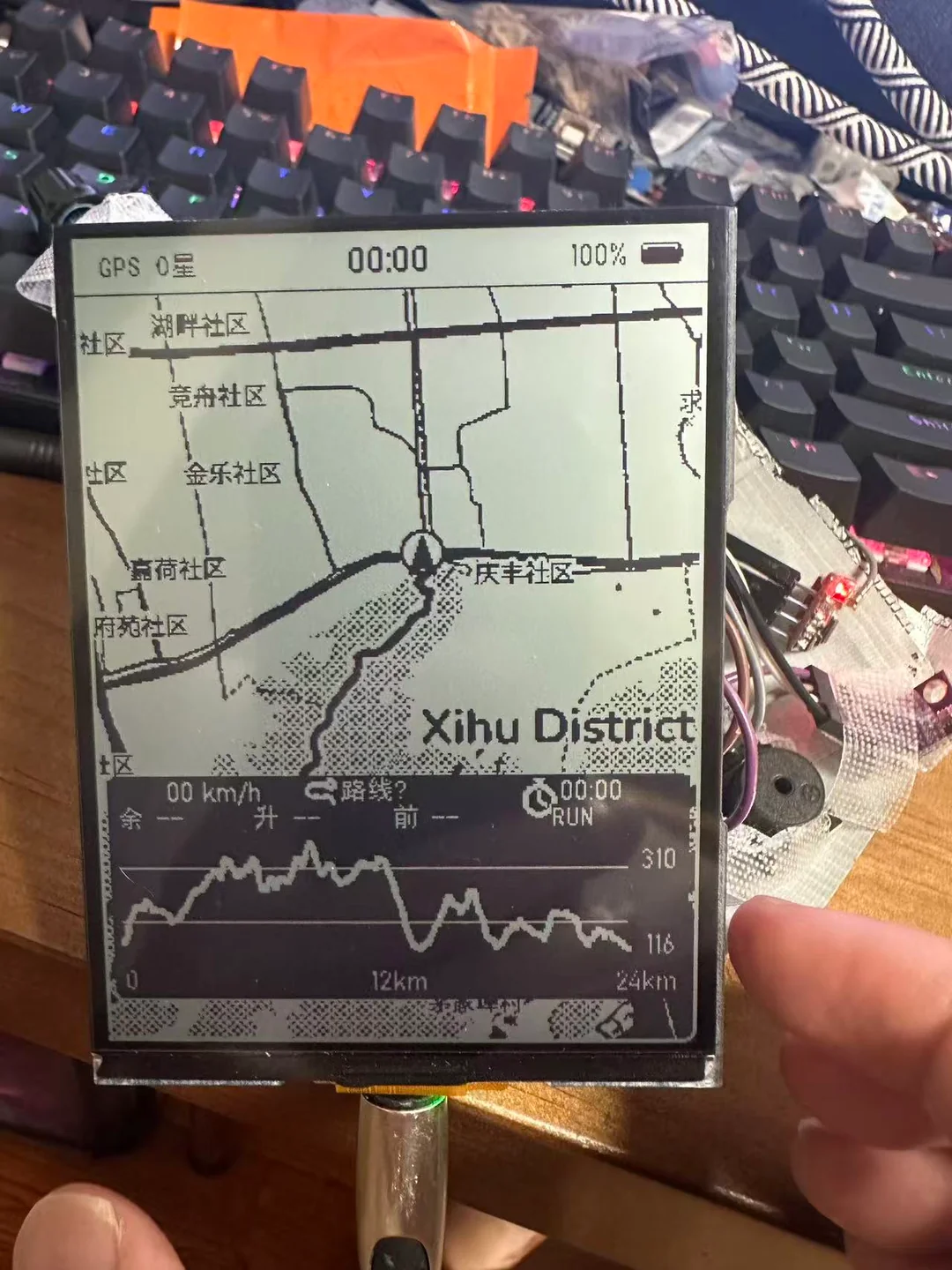
Mountable on e-bikes, trail rigs, or Outdoor IoT Display telemetry nodes for real-time GPS maps and sensor readouts under direct sunlight.
-
Smart Home Dashboards:
A sleek Low Power GUI interface for Home Assistant via ESPHome to monitor energy stats, climate controls, and security feeds.
🔗 See Create a DIY Smart Chatbot Lamp with ESP32 ChatGPT Voice Assistant
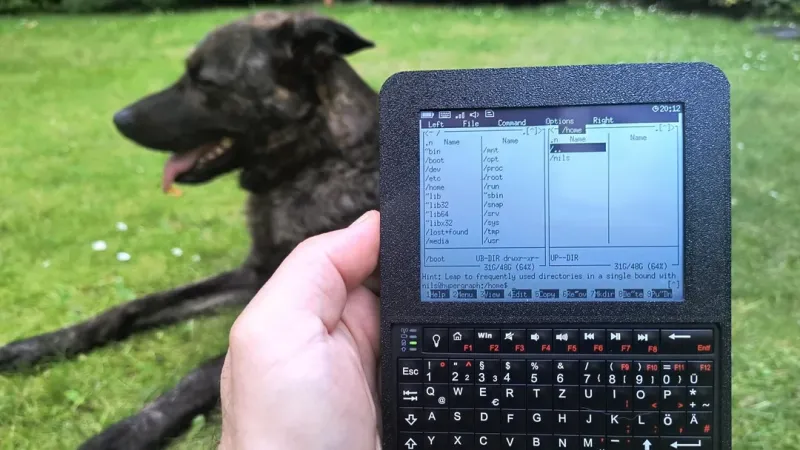
🛠️ Software Frameworks & Display Driver
| Development Framework | Display Driver Integration | Ideal Target Application |
Arduino RLCD |
LVGL (v8.3 / v9.3) / U8g2 | Rapid prototyping, basic IoT widgets, and sensor test scripts |
ESP-IDF Display |
LVGL / Native ST7305 SPI | Commercial-grade products, multi-threaded FreeRTOS, deep-sleep tuning |
PlatformIO (VS Code) |
LVGL / Custom Drivers | Professional C++ development with automated library management |
ESPHome |
ST7305 Native Driver | No-code Home Assistant dashboards via simple YAML configuration |
Unboxing & Practical Considerations
Before choosing the Waveshare ESP32-S3 4.2 RLCD for your next build, keep these real-world insights in mind:
-
Dark Environment Readability:
This Ambient Light Display lacks an integrated front-light or backlight. In total darkness, it is unreadable. Nighttime indoor projects will require a nearby lamp or a custom front-lit LED strip.
-
SHTC3 Sensor Thermal Coupling:
The onboard climate sensor sits near the display drive circuitry. Under heavy Wi-Fi activity or continuous speaker playback, PCB heat can cause humidity and temperature readings to skew high. For high-precision weather logging, use an external I2C sensor via the expansion header.
-
Acrylic Stand Assembly:
The included laser-cut stand pieces fit snugly, but handle them gently during initial setup to avoid snapping the tabs.
-
Reverse-Polarity Protection:
Waveshare included a dedicated WRN LED near the 18650 holder, giving a visual warning if a Li-ion cell is inserted backward.
🎯Final Verdict: Buyer’s Decision Guide
| Project Requirement | Recommended? | Key Reason & Alternative Recommendation |
Outdoor IoT Display & Solar Telemetry |
Yes (✅) | Superior Sunlight Readable ESP32 Display with low active power draw |
Desktop DeepSeek ESP32 AI Assistant |
Yes (✅) | Integrated voice pipeline, responsive Low Power GUI, zero ambient glare |
Battery Powered Display Dashboards |
Yes (✅) | Fast refresh r0ates allow smooth LVGL ESP32 menus without e-ink latency |
Full-Color Media & Video Playback |
No (❌) | Display is monochrome; choose IPS or AMOLED panels instead |
Static Shelf Labels (Updated 1x/day) |
No (❌) | E-Paper remains superior for zero-power static image retention |
24/7 Always-On Use in Dark Rooms |
No (❌) | RLCD requires ambient light; needs an external light source in darkness |
How to Assemble the Waveshare ESP32-S3-RLCD-4.2 in Minutes! (video)
ESP32-S3 RLCD 4.2-inch Development Board from Waveshare! Compare RLCD vs E-paper & IPS. Is this sunlight-readable AIoT board with AI voice the E-paper killer?
Conclusion
The Waveshare ESP32-S3 4.2 RLCD isn’t trying to replace high-resolution smartphone screens or ultra-static E-paper tags. Instead, it serves as an ideal ESP32-S3 E-paper Alternative, striking a perfect balance in embedded display design: delivering responsive, animated, sunlight-readable graphical interfaces at an accessible price point.
When combined with LVGL ESP32 interfaces, onboard audio hardware, and cloud LLM streaming, this ESP32-S3 Display Board stands out as one of the most versatile, innovative platforms available for modern IoT developers and makers today.
👉 Stop scrolling. Start building. Find your next piece of hardware at the Siqma store .
Frequently Asked Questions (FAQ)
Q1: What is the Waveshare ESP32-S3 4.2 RLCD used for, and what can I build with it?
The Waveshare ESP32-S3 4.2 RLCD is a low-power RLCD Development Board engineered for outdoor IoT devices, battery-powered dashboards, and conversational ESP32 AI Assistant hardware requiring sunlight readability.
Key Applications:
- Outdoor IoT Display & Sensors: Solar weather stations and telemetry readers.
- Voice AI Companions: Desktop agents powered by the AI voice DeepSeek ESP32 pipeline.
- Smart Home Hubs: Low-power ESPHome / Home Assistant dashboards.
- Ambient Desktop Widgets: Digital calendars, live clocks, and battery monitors.
Q2: How does RLCD compare to E-Paper (E-Ink) displays on this ESP32 board?
Unlike E-Paper screens that refresh slowly(1-3 seconds per frame), the Waveshare ESP32-S3 4.2 RLCD delivers fast, flicker-free refresh rates (tens of frames per second) for smooth user interfaces while maintaining an eye-friendly, paper-like readability.
RLCD vs E-Paper Advantages:
- Smooth LVGL ESP32 UI: Supports animated menus, interactive sliders, and audio visualizers.
- No Full-Screen Flashing: Eliminates screen flashing during visual transitions.
- Superior ESP32-S3 E-paper Alternative: Ideal for interactive applications rather than static text.
Q3: Is the Reflective LCD ESP32 screen visible in direct sunlight? Does it have a backlight?
Yes, the Reflective LCD ESP32 display relies 100% on ambient light reflection and has no internal LED backlight, making it clearer and sharper under intense direct sunlight.
Light Behavior:
- Direct Sunlight: Peak contrast and maximum readability.
- Bright Indoor Light: Excellent visual clarity.
- Dark Rooms: Unreadable without an external light source or desk lamp.
Q4: Why does the Waveshare ESP32-S3 4.2 RLCD look dim in dark environments?
The panel is an Ambient Light Display with zero internal light emission; its visual contrast depends entirely on external room light to reflect off the screen backplate.
Design Trade-off: Sacrifices dark-room illumination to achieve ultra-low power draw and glare-free eye comfort.
Night Use Requirement: Requires ambient room light or an external light fixture to be readable in low-light settings.
Q5: How long does the battery last on the Waveshare ESP32-S3 4.2 RLCD?
Battery life ranges from 6 to 12 hours during continuous Wi-Fi and audio streaming, up to several weeks in RTC deep-sleep clock mode using a single 18650 Li-ion battery.
Power Breakdown:
- Active Wi-Fi & Voice AI: 150-300 mA draw (6-12 hours runtime).
- Factory Standby Demo: approx 24 hours continuous execution.
- Deep Sleep Mode: Uses onboard PCF85063 RTC for multi-week battery life.
- First-Power Activation: Must connect USB-C once after inserting a new battery to initialize power logic.
Q6: How does AI Voice DeepSeek ESP32 integration work on this board?
The board captures user speech via a dual-microphone array and ES7210 ADC, streaming the audio over Wi-Fi to cloud LLM APIs like the DeepSeek API ESP32 before playing voice responses through its ES8311 codec and speaker.
Audio Architecture:
- Input: Dual MEMS Mics + ES7210 ADC (Hardware Noise Reduction & AEC).
- Processing: ESP32-S3 routes I2S streams to cloud AI endpoints (DeepSeek / Xiaozhi AI).
- Output: ES8311 Codec 2w speaker for real-time voice playback with concurrent ESP32 GUI updates.
Q7: Which software frameworks and drivers support the Waveshare ESP32-S3 4.2 RLCD?
The board uses an ST7306 driver IC over SPI and is officially supported by Arduino IDE, ESP-IDF, PlatformIO, and community ESPHome custom components.
Supported Libraries:
- LVGL ESP32 (v8 / v9): Supported via Waveshare’s BSP using 8 MB PSRAM for framebuffers.
- LovyanGFX & U8g2: Ideal for lightweight custom graphic layouts.
- Arduino RLCD Core: Compatible with arduino-esp32 v3.3.0+.
Q8: How do I resolve USB recognition or flashing failures on the ESP32-S3 RLCD board?
To force the board into ROM Download Mode when flashing fails, hold the onboard BOOT button, press and release the PWR/Reset button, then release the BOOT button.
Troubleshooting Steps:
- Force ROM Download Mode using the BOOT + PWR button sequence.
- Enable Octal PSRAM in your IDE/compiler settings.
- If the red WRN LED turns on when installing an 18650 battery, remove it immediately to protect against reverse polarity.