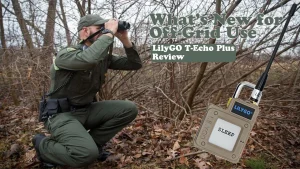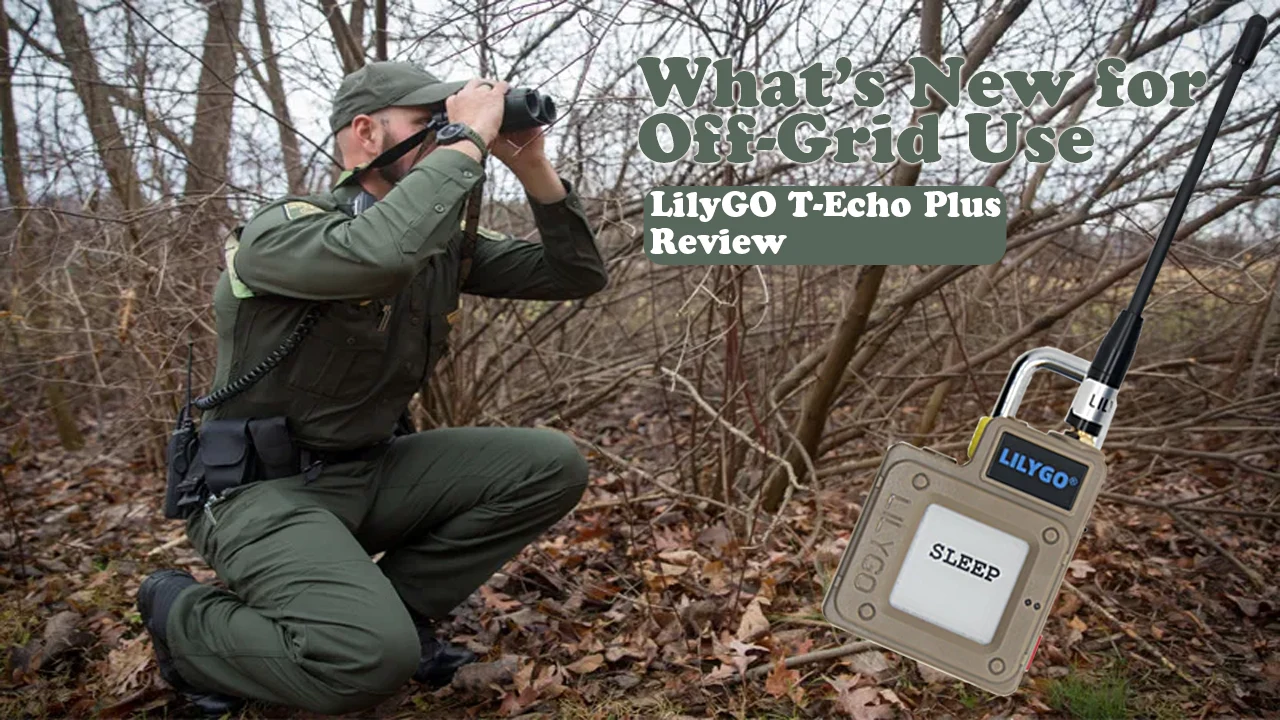
LilyGO T-Echo is designed for people who want to stay connected without relying on mobile operators, SIM cards, or the internet. From everyday users and hikers to privacy focused individuals, many people ask questions like “How can we chat without internet or a SIM card?” or “Is it possible to send messages off grid?” In a world where reliable connectivity can mean the difference between adventure and isolation, the LilyGO T-Echo Plus stands out as a true game changer for off grid communication. Building on the solid foundation of the original T-Echo, this upgraded version delivers real improvements while keeping the open source philosophy that users trust.
Designed for hikers, cyclists, outdoor explorers, emergency responders, and remote workers, the T-Echo Plus goes far beyond a typical development board. The Plus version introduces a larger battery for longer use, improved motion tracking, vibration and haptic feedback, support for stronger external antennas, and smarter mounting options. These upgrades make it an excellent choice for Meshtastic mesh networks, offering secure, device to device messaging with no cellular network required and a strong focus on privacy and independence.
Features & Capabilities
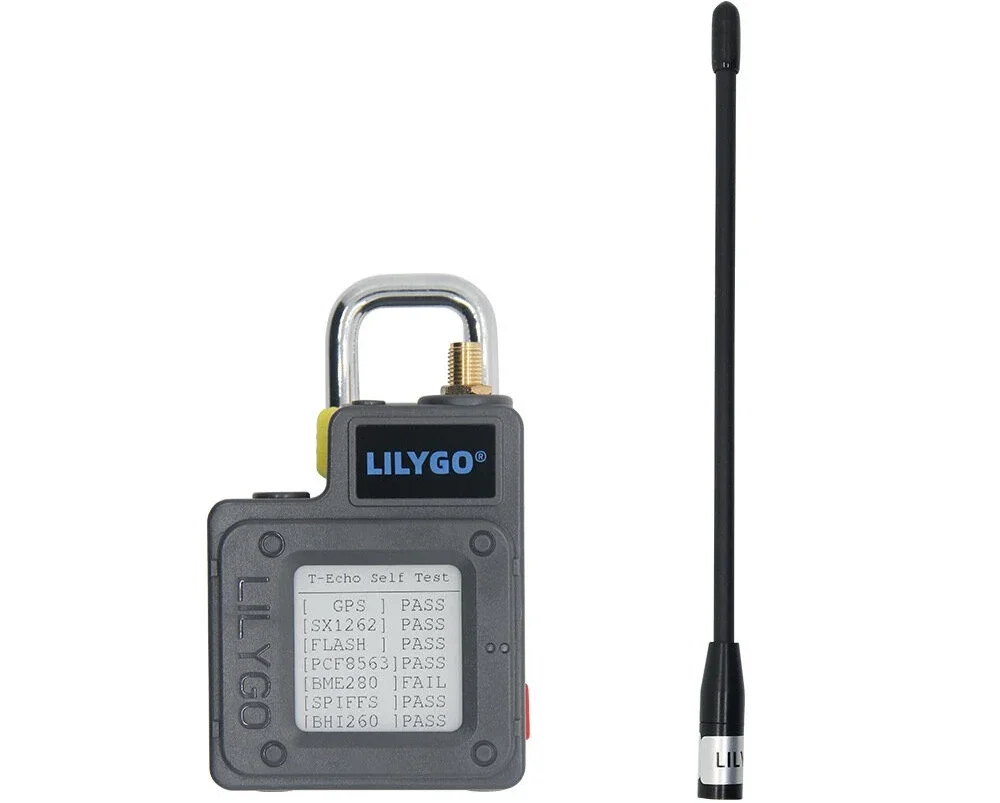
The LilyGO T-Echo Plus is a compact powerhouse built for serious off-grid communication, combining rugged durability with smart, energy-efficient technology. Encased in a weather-resistant shell with an integrated climbing hook (carabiner-style) and ¼-inch mounting point, it’s designed to clip effortlessly onto backpacks, belts, or gear , perfect for hikers, cyclists, adventurers, and emergency responders.
At its heart lies the Nordic nRF52840 SoC , a 64 MHz Arm Cortex-M4F processor with hardware floating-point support , delivering excellent multitasking performance. Wireless flexibility is exceptional, supporting Bluetooth 5, Bluetooth Mesh, Thread, Zigbee, ANT, IEEE 802.15.4, and even NFC, while the real long-range star is the Semtech SX1262 LoRa transceiver. Operating across global sub-GHz bands (433/868/915/920 MHz), it offers up to +22 dBm transmit power and -148 dBm sensitivity, paired with an external SMA antenna connector for dramatically improved range compared to the original T-Echo.
Positioning is handled by the L76K multi-constellation GNSS module (GPS, GLONASS, BeiDou, QZSS), enabling accurate location tracking and distance measurement even in the most remote areas. The BHI260AP 6-axis IMU brings advanced AI-enhanced motion sensing, delivering precise activity recognition and ultra-low-power context awareness , a noticeable step up from the previous model.
User interaction remains intuitive and highly visible thanks to a 1.54-inch e-paper display (200×200 resolution, 2-level grayscale). Sunlight-readable and extremely power-efficient (only consuming energy during refresh), it updates in about 2 seconds and stays perfectly legible outdoors. Feedback is further enhanced with a vibration motor for haptic alerts, a buzzer for audible notifications, and dual status LEDs. Four front-facing buttons plus a dedicated power/RTC button make operation straightforward even with gloves.
Powering everything is a generous 2400 mAh rechargeable lithium battery via USB-C , nearly triple the capacity of the original T-Echo’s ~850 mAh, translating into significantly longer field runtime and real-world reliability.
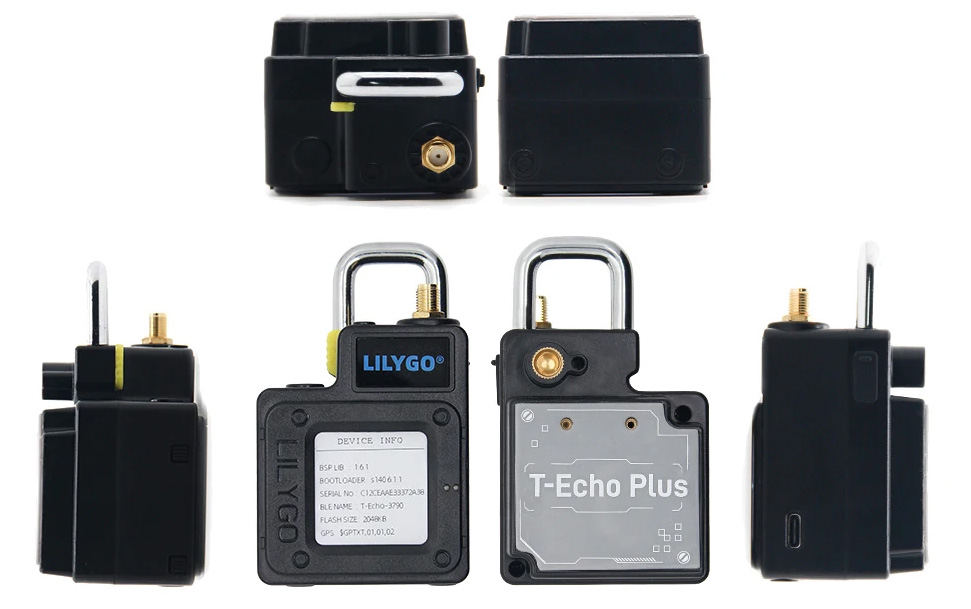
Key upgrades that make the T-Echo Plus stand out:
- Much larger 2400 mAh battery for extended missions
- Integrated climbing hook and ¼-inch mount for secure attachment
- AI-powered BHI260AP IMU for smarter, more precise motion tracking
- Haptic vibration motor + buzzer for better user feedback
- External SMA antenna connector for superior LoRa range
Typical Applications
The LilyGO T-Echo Plus truly shines in its versatility, excelling in real-world scenarios where traditional networks simply can’t keep up. From off-grid adventures to practical IoT deployments, this compact device delivers reliable, long-range performance without compromise.
Meshtastic Networking & Off-Grid Communication
As a fully Meshtastic-compatible node, the T-Echo Plus powers decentralized LoRa mesh networks, enabling seamless text messaging, GPS location sharing, and group coordination over kilometers , no cellular towers required. It’s the perfect tool for staying connected in remote areas, whether you’re hiking with friends or coordinating in the backcountry.
Outdoor Adventures, Hiking & Cycling
With its rugged, weather-resistant build, integrated climbing hook (carabiner-style), and ¼-inch mount, the T-Echo Plus attaches effortlessly to backpacks, belts, or gear , becoming a true hands-free companion. Hikers and cyclists love it for real-time messaging, route tracking, and even sending emergency alerts when cell service vanishes.
Search and Rescue & Emergency Response
The built-in L76K GNSS module provides precise positioning (GPS, GLONASS, BeiDou, QZSS), making the T-Echo Plus invaluable for search-and-rescue operations in rugged terrain. Combined with long-range LoRa messaging and haptic/audible alerts, it helps teams coordinate effectively when every meter counts.
🔗 See Animal Tracking Network: LoRa + GPS for Offline Location
Asset Tracking & Telemetry
Its ultra-low power consumption and robust sensors make it ideal for long-term asset monitoring. Attach it to vehicles, equipment, or valuable gear to track location and movement over extended periods , perfect for field operations, surveying, or even drone/aviation telemetry via SoftRF compatibility.
Environmental Monitoring & IoT Applications
Pairing LoRa’s exceptional range with Bluetooth, Thread/Zigbee, and optional sensors (like the BME280), the T-Echo Plus works great as an IoT endpoint for remote environmental data logging , think weather stations, wildlife tracking, or agriculture monitoring , all while sipping minimal power.
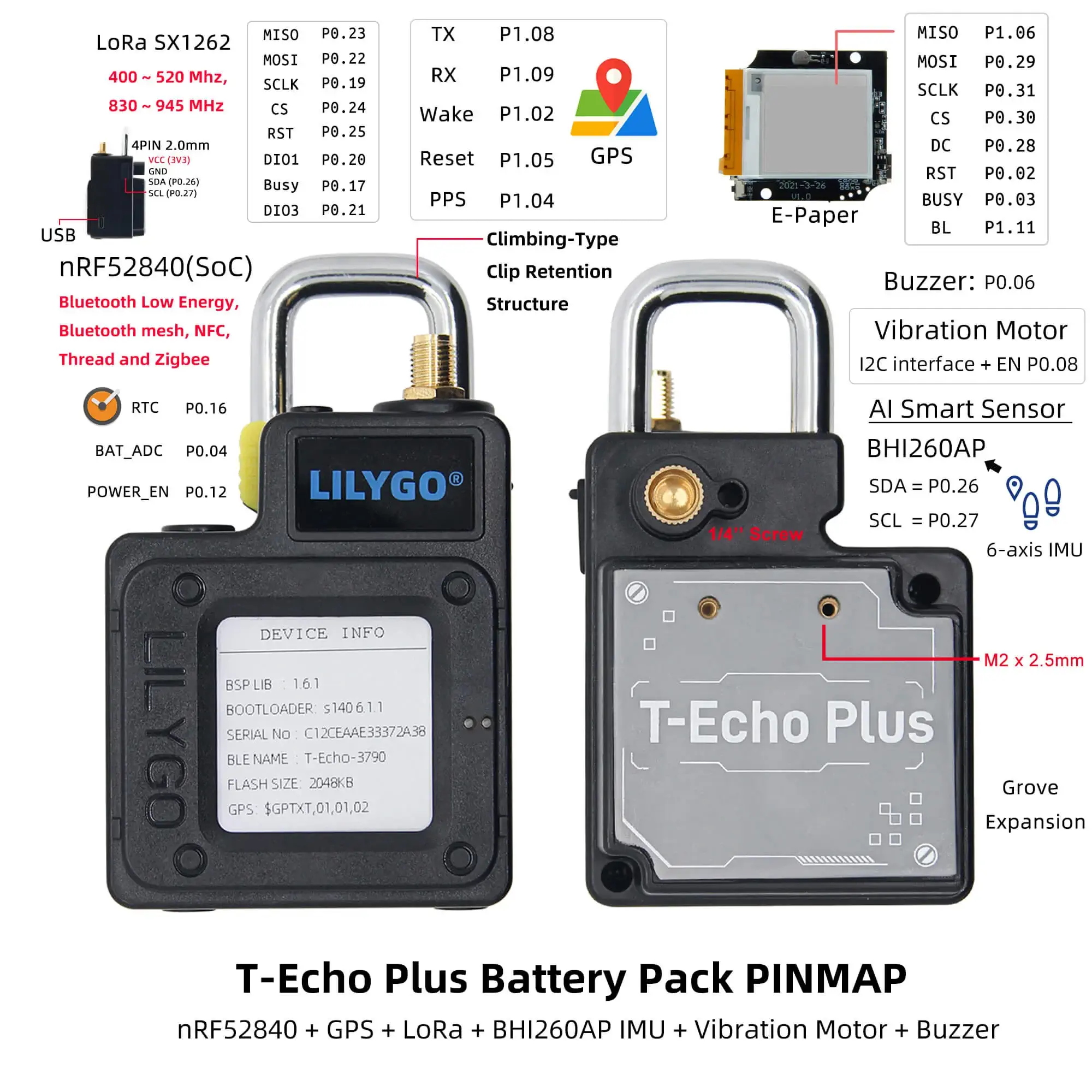
LilyGO T-Echo Plus – Full Technical Specifications
| Category | Specification |
|---|---|
| Microcontroller | Nordic nRF52840 (Arm Cortex-M4F @ 64 MHz with hardware floating-point unit) |
| Memory | 2 MB Flash + 2 MB RAM |
| Wireless Connectivity | Bluetooth 5, Bluetooth Mesh, Thread, Zigbee, ANT, IEEE 802.15.4, NFC |
| LoRa Transceiver | Semtech SX1262 (Supports 433 / 868 / 915 / 920 MHz, up to +22 dBm TX, -148 dBm sensitivity) |
| Modulation | LoRa / GFSK |
| Antenna | External SMA connector + long external antenna |
| Display | 1.54-inch SPI E-Paper / e-ink, 200×200 resolution, 2-level grayscale, ~2s refresh, sunlight-readable |
| GNSS / Positioning | Quectel / L76K module (GPS, GLONASS, BeiDou, QZSS) |
| IMU / Motion Sensor | BHI260AP 6-axis smart sensor (AI-enhanced, ultra-low power, activity recognition) |
| Environmental Sensor | Optional BME280 (temperature + pressure) |
| Real-Time Clock (RTC) | PCF8563 |
| User Feedback | Vibration motor (haptic), Buzzer (audible), 2× status LEDs |
| User Interface | 4× front-facing buttons, Touch button (TTP223), Reset button, Boot button, Power/RTC button |
| Expansion | Grove interface, 8-pin GPIO header (6× GPIO), 2× MFP connectors, SWD debug interface |
| Battery | 2400 mAh rechargeable lithium battery, USB-C charging (with ESD protection & battery monitoring) |
| Power Management | Advanced low-power modes |
| Mounting & Enclosure | Integrated climbing hook (carabiner-style), ¼-inch tripod mount, M2 screw holes, rugged weather-resistant design |
| Dimensions | Main body: approx. 89 × 53 × 45 mm (without antenna) With hook: approx. 128 × 53 × 26 mm (varies slightly by source) |
| Antenna Length | ~174 mm (external) |
| Other Features |
Firmware-dependent features (e.g., IMU gestures, vibration patterns), Meshtastic & SoftRF compatible |
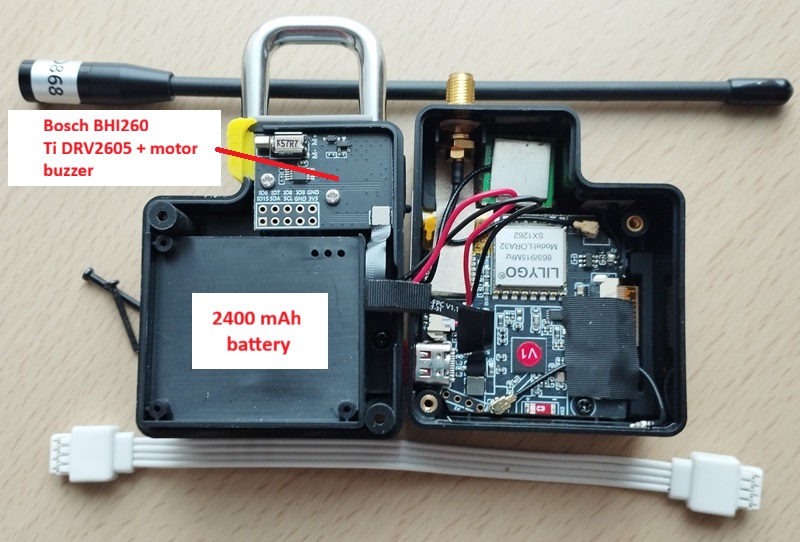
Included Accessories & Practical Design
Out of the box, the T-Echo Plus comes ready for real-world use with key additions that enhance portability and performance:
- An external SMA antenna for significantly better LoRa range (far superior to the small stubby antenna found on many similar devices).
- A built-in climbing hook (carabiner-style) for easy attachment to backpacks, belts, or gear , ideal for hiking, cycling, or any outdoor activity.
The device also features a 1/4-inch tripod mount for stable setups and a Grove port for quick expansion with additional sensors or modules (like the optional BME280 for temperature and pressure monitoring). Users can further boost range by swapping in higher-gain antennas via the IPEX/SMA connector , often achieving over 10 km in clear Line-of-Sight (LoS) conditions.
Software Ecosystem & Meshtastic Integration
The T-Echo Plus is built around open-source principles, making it highly customizable. It typically ships with Meshtastic firmware pre-installed (or is fully compatible), the leading open-source platform for decentralized, off-grid mesh networking. With Meshtastic, you can send encrypted messages, share locations, and exchange telemetry , all without relying on cellular networks or central servers.
Pairing is seamless: connect via Bluetooth to the official Meshtastic mobile app (available on Android and iOS) for easy configuration and chatting.
Setup is straightforward , flash the firmware via USB, configure channels through the app or web interface, and join mesh networks instantly. Over-the-air (OTA) updates keep everything current without needing to open the device.
Note: While core features work plug-and-play, some of the Plus model’s extras (like the vibration motor or advanced IMU capabilities) may require custom firmware builds in certain Meshtastic releases, as full sensor support is still evolving.
For developers, the options are extensive:
- Arduino IDE and PlatformIO for quick sketching and prototyping.
- Nordic SDK with Zephyr RTOS for advanced real-time applications.
- Sample code and firmware releases available directly on LilyGO’s GitHub.
- Compatibility with projects like SoftRF and SkyTracker for aviation-focused use cases.
Whether you’re setting up a personal Meshtastic network for group adventures, experimenting with custom sensors, or building long-range communication solutions, the T-Echo Plus delivers a robust, expandable ecosystem backed by a vibrant open-source community. It’s not just a device , it’s a platform designed to grow with you.
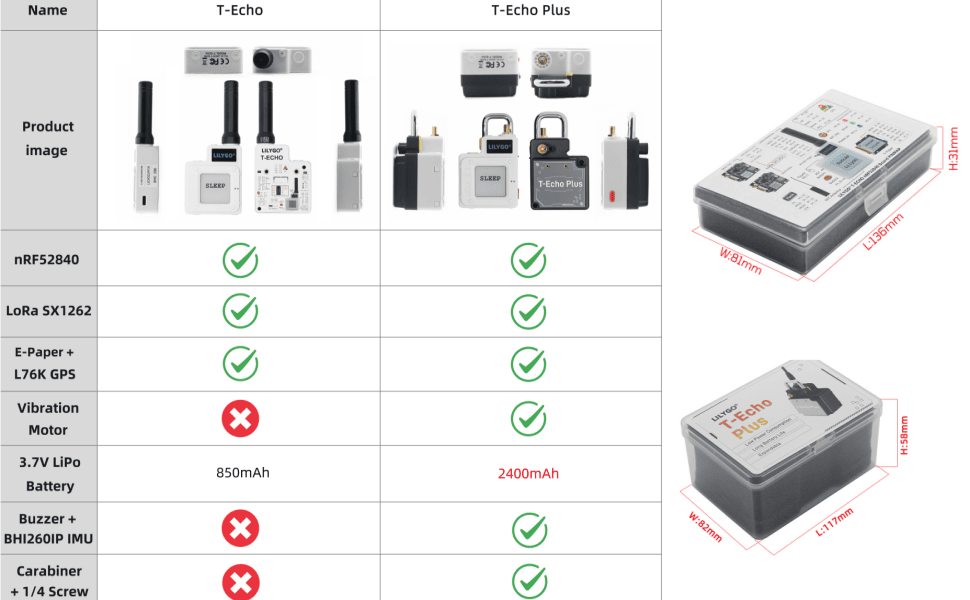
T-Echo Plus vs T-Echo: What’s New?
Many users ask about the difference between the T-Echo Plus vs T-Echo. The internal processing core (nRF52840) remains similar, but the user experience is vastly improved in the Plus model:
- Enclosure: The Plus features the rugged climbing hook design.
- Sensors: The original used a basic accelerometer; the Plus uses the intelligent BHI260AP.
- Controls: The Plus includes a magnetic reset button and improved tactile buttons, addressing accidental presses common in the original version.
- Feedback: The addition of a buzzer allows for audible alerts, which was missing in earlier iterations.
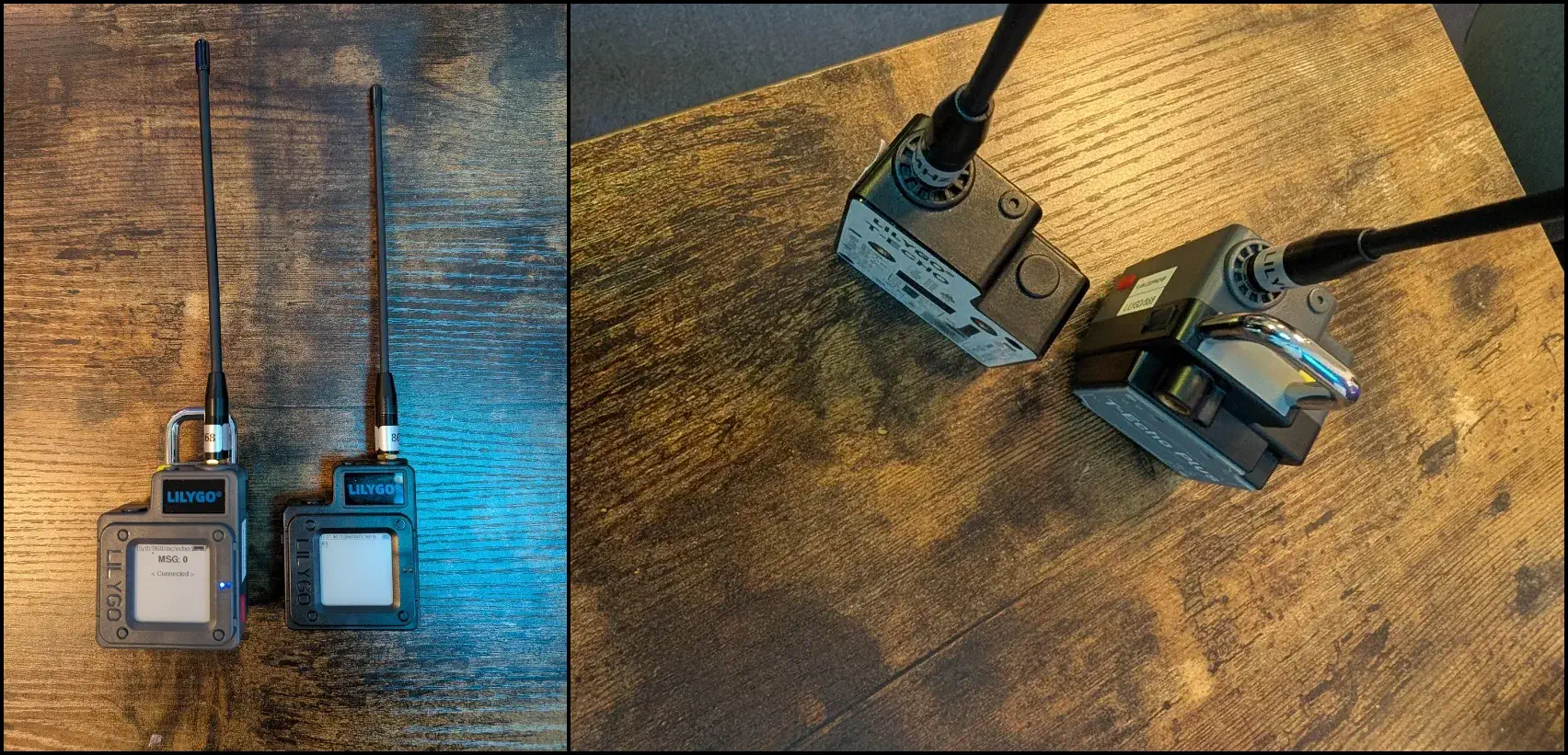
Key Hardware & Usage Considerations
E-Ink Display Limitations
The 1.54-inch e-paper screen is a battery-saving superstar (consuming almost no power when static), but its refresh rate is slow , around 2 seconds per update. This makes it excellent for reading messages, viewing maps, or checking status in bright sunlight, but unsuitable for animations, rapid scrolling, or video-like updates.
Frequency Selection & Legal Compliance
LoRa operates on regional bands (433 MHz, 868 MHz, 915 MHz, or 920 MHz). Always choose the correct variant for your country to stay within local radio regulations , buying the wrong one can limit performance or even make it illegal to use. Check your region’s rules before ordering.
📖 Also read Offline ESP32 IoT Project with ESP-NOW and LoRa
Battery Life in Real-World Scenarios
The massive 2400 mAh battery, paired with the ultra-low-power e-ink display, delivers impressive endurance , often days of intermittent messaging and light GPS use. However, frequent LoRa transmissions, constant GNSS polling, or heavy sensor activity will drain it faster. Plan for USB-C recharges on long outings.
Antenna & Range Factors
The included external SMA antenna (often a 174mm whip) offers a big step up from stubby internals, with real-world tests showing multi-kilometer range in open terrain thanks to the SX1262’s excellent sensitivity (-148 dBm). Urban environments, obstacles, or interference can reduce this. Many users upgrade to higher-gain antennas for even better results.
Firmware, Features & Meshtastic Notes
Meshtastic Compatibility
The device is fully Meshtastic-ready (often pre-flashed), allowing easy encrypted messaging, location sharing, and mesh networking via the mobile app. Core functions work plug-and-play, but advanced Plus features like the vibration motor, buzzer, and full AI capabilities of the BHI260AP IMU may need custom firmware or community patches , especially in early releases. Check the Meshtastic GitHub or forums for the latest support.
Developer Tip for BHI260AP
To unlock the sensor’s full AI-enhanced motion intelligence (activity recognition, low-power context awareness), use Bosch-specific libraries or LilyGO-provided code, standard accelerometer drivers won’t cut it.
Range vs Original T-Echo
LoRa performance is generally comparable, though the Plus’s external antenna setup often gives a slight edge depending on terrain and setup.
T-Echo Plus Close-Up Hands-On
Take a close-up look at T-Echo Plus and see how it really feels in your hand !
Conclusion
In last, the LilyGO T-Echo Plus represents a meaningful and worthwhile evolution of the popular T-Echo series. Launched in late 2025, it has quickly captured attention for its hiking-ready, rugged design , complete with an integrated climbing hook for effortless backpack or gear attachment , along with substantial upgrades that enhance real-world usability.
Priced affordably between $64–80, the T-Echo Plus delivers exceptional value for outdoor adventurers, privacy-focused users, and Meshtastic enthusiasts who want longer battery life, smarter AI-enhanced sensors (like the BHI260AP IMU), tactile feedback via vibration and buzzer, and more reliable off-grid performance. While the original T-Echo remains a solid, budget-friendly choice for basic needs, the Plus version refines the entire concept into a more polished, versatile, and future-proof portable LoRa communicator.
By blending the ultra-low-power longevity of its sunlight-readable E-ink display, precise GNSS tracking, versatile connectivity, and seamless Meshtastic integration, the T-Echo Plus stands out as a must-have tool for anyone building resilient mesh networks, exploring remote areas, or simply staying connected where traditional signals fail. Whether you’re upgrading from the classic model or stepping into LoRa for the first time, it offers robust, reliable, and remarkably user-friendly performance , truly one of the most practical choices in the fast-growing off-grid and IoT communication ecosystem.
👉 Ready for an upgrade? Pop into the Siqma store to see what’s new, you might just find exactly what you didn’t know you needed.
Faq
-
What is LilyGO T-Echo Plus used for?
The LilyGO T-Echo Plus is mainly used for LoRa and Meshtastic projects. It’s popular for off-grid messaging, emergency communication, GPS tracking, and long-range wireless networks where internet access is limited or unavailable.
-
How far can LilyGO T-Echo Plus communicate using LoRa?
In open areas, it can reach several kilometers. Actual range depends on antenna quality, terrain, obstacles, and transmission settings. In real-world use, it often outperforms Wi-Fi and Bluetooth by a wide margin.
-
Can LilyGO T-Echo Plus work without internet or cellular service?
So yes. That’s one of its biggest advantages. It communicates directly with other LoRa devices, making it ideal for outdoor adventures, disaster recovery, and remote locations.
-
How to power LilyGO T-Echo Plus?
It can run on a rechargeable Li-Po battery and also supports USB power. This makes it portable and suitable for long-term, mobile, or outdoor deployments.
-
Can we program T-Echo Plus with Arduino or PlatformIO?
Yes, it works well with Arduino IDE and PlatformIO. Developers can easily customize firmware, add sensors, or build custom LoRa applications on top of the ESP32 platform.
-
What is the range of the T-Echo Plus with the stock antenna?
Typically 1-5 km in open areas, but up to 10 km with line-of-sight. Urban spots drop to 500m-1km due to obstacles. Upgrade the antenna for better performance, users report doubled range. Factors like frequency (LoRa 868/915MHz) and power settings matter.
-
How do we upgrade the antenna on the LilyGO T-Echo Plus?
Unscrew the stock antenna and attach a higher-gain one (e.g., 5dBi SMA). Ensure compatibility with SX1262 frequencies. Users report better signal in dense areas, never power on without an antenna to avoid damage.
-
How long does the battery last on the T-Echo Plus?
The 2400mAh battery lasts 5-10 days in low-power mode (e.g., occasional messaging). Heavy GPS use cuts it to 1-2 days. Recharge via USB-C; some users add solar panels for extended outdoor trips. Firmware optimizations in Meshtastic help conserve power.
-
Does the LilyGO T-Echo Plus have GPS and how accurate is it?
Yes, with L76K GNSS for positioning. Accuracy is 5-10 meters outdoors, aided by AGNSS for faster fixes. Use it for tracking in Meshtastic, great for hiking. Indoor performance drops; pair with apps for maps.
-
Why is GPS not locking indoors on T-Echo Plus?
The integrated L76K GNSS module is very efficient but requires a clear view of the sky for the initial “Cold Start.” Users often complain about this; the solution is to take the device outside for 5–10 minutes for the first lock. Once it has the “almanac” data, subsequent locks (Warm Starts) are much faster.
-
Why is T-Echo screen not refreshing or showing artifacts?
This is a common trait of E-Paper displays. Ensure you are using the latest firmware, as updates often include “ghosting” fixes. If the screen seems stuck, a “Triple-press” of the reset button or a full power cycle usually forces a refresh. Also, remember that E-Paper performs poorly in extreme cold.
-
How do I flash Meshtastic firmware on the T-Echo Plus?
Use the Meshtastic Web Flasher: Connect via USB, select your device, and upload the latest firmware (e.g., for 868MHz in Europe or 915MHz in the US). Back up first. On X and GitHub, users recommend Arduino IDE for custom tweaks, ensure drivers are installed for nRF52840.
-
How do I pair the LilyGO T-Echo Plus with the Meshtastic app?
Flash Meshtastic, then in the app (Android/iOS), tap the plus icon, select your node, and enter the PIN shown on the device’s screen. Bluetooth connects for config, set region, channels, and user name. Troubleshooting: Ensure Bluetooth is on and firmware matches.
-
Is the T-Echo Plus waterproof or rugged for outdoors?
It’s splash-resistant but not fully waterproof (IP54-ish). The climbing hook makes it portable for cycling/hiking. Add a case for extra protection; users in rainy climates recommend silicone covers.